Sign off pending OEM toy development options against a named specification revision, with each option marked approved, conditionally approved, or held—and state exactly which next step that decision authorizes. For a magnetic steel ball drawing board, settle the board-and-pen configuration and drawing-play assortment role before approving color, logo, or box changes. Then link the quoted sales unit, customization terms, artwork, and identified sample in one record, so approval of a design does not become accidental permission to produce.
For projects with OEM toy manufacturers in China, the useful deliverable is a bounded release decision: permission to quote, prepare artwork, make a sample, or start production. Those are separate decisions. A completed checklist records authorization; it is not a product certification.
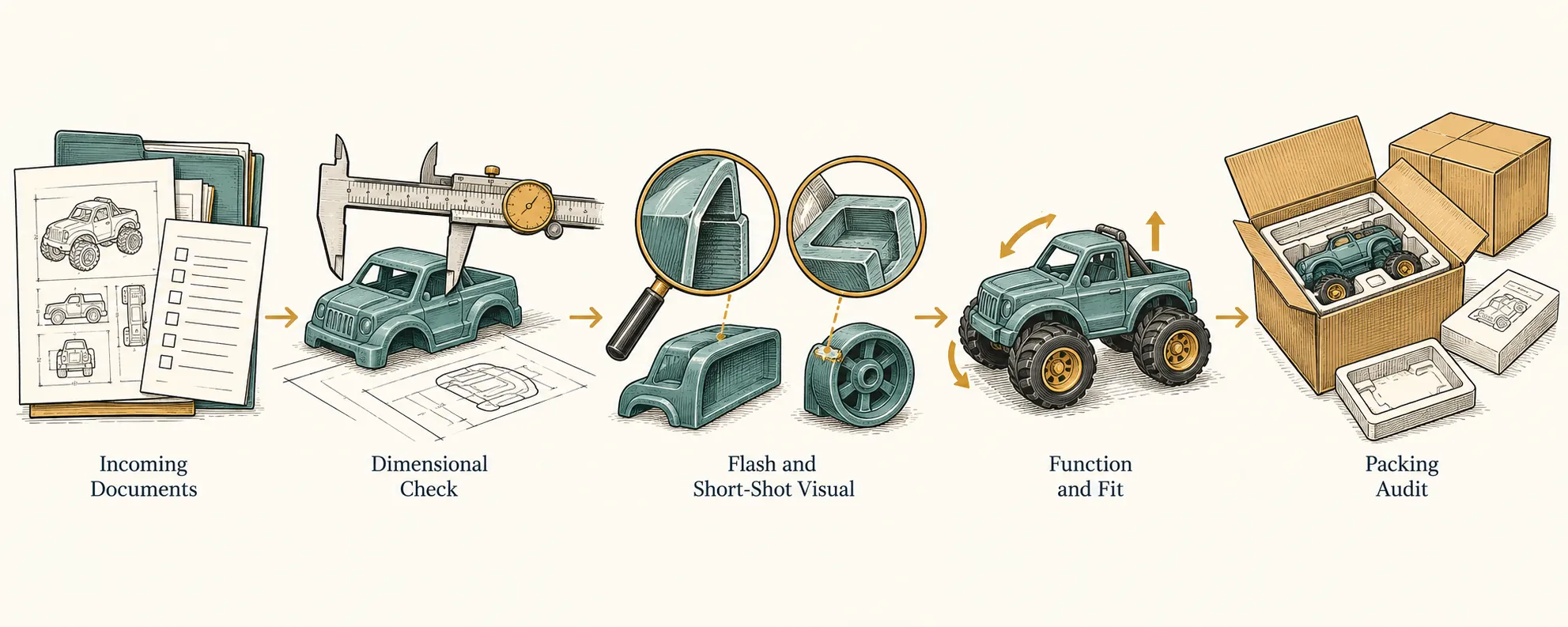
What product configuration should the buyer approve first?
Approve the play mechanism, included components, and intended assortment role before reviewing decorative options. Otherwise, two attractive quotations may describe different products.
The Magnetic Steel Ball Drawing Board provides a concrete starting point: its catalog description records an ABS plastic case, magnetic board, metal marbles, and magnetic pen, with color-box packing. For an assortment built around drawing play, retain those elements in the specification and ask for a demonstration of how the pen interacts with the marbles.
The October 9, 2026 catalog snapshot records a reference MOQ of 1,800 and 360 units per carton. Keep these as separate fields. Ask the supplier to confirm the quoted sales unit, included components, current MOQ, and packing configuration for the exact requested version. Neither figure establishes a custom-color minimum, an order multiple, or available inventory.
Keep the manufacturer's product identifier in the project record alongside the buyer's item name and revision. The identifier tracks the catalog item; the revision identifies the configuration being approved.
Should you retain the catalog finish or request custom color, logo, and packaging?
Retain the catalog finish when changing the toy itself is unnecessary; request custom color only when a defined brand-color requirement justifies a separate color approval. Compare every route using the same proposed sales unit and included components.
For the drawing-board example, request one quotation retaining the supplier's confirmed existing finish and color-box design. Ask which colors are currently available, in what quantities, and under what reorder conditions. A listed color is a design reference, not a stock commitment.
A logo-and-box route can retain that same board configuration while requesting a specified logo process, position, and revised packaging. Confirm feasibility and any minimum quantity for those exact changes. Do not assume a missing customization listing means the request is impossible—or that the catalog MOQ automatically covers it.
A custom-case-color route needs its own color reference, acceptance method, sample, and quantity confirmation. Ask for the minimum quantity for the requested color and the complete configuration, including logo and box. Do not add unrelated minimums together.
Keep price comparisons on the same basis: one identically configured boxed unit against another. List setup charges separately, and ask whether unused printed packaging or color-specific components create commitments for reorders.
What should a completed pending-options signoff record contain?
| Project identity and revision | Hypothetical project: Drawing Board Brand Refresh. Specification: Rev B. Record the manufacturer's product identifier, supplier quotation revision, artwork revision, and sample identifier together. Observation: this review defines a request; it does not record an inspected sample. Decision: approved for quotation and artwork preparation only. Approver/date: buyer project lead, October 28, 2026. |
|---|---|
| Product configuration and assortment role | Catalog fact: ABS plastic case, magnetic board, metal marbles, magnetic pen. Target: retain the drawing mechanism for a drawing-play assortment; document the component list and marble arrangement on the supplier drawing. Observation: catalog description reviewed; physical operation not inspected. Decision: approved as the quotation baseline, not as verified sample performance. Approver/date: product lead, October 28, 2026. Follow-up: supplier engineer to submit the configuration drawing for buyer review. |
| Quoted sales unit and quantity basis | Target: quote one retail box containing one drawing board and one magnetic pen, with the board's marble configuration identified separately. Do not price each embedded marble as a sales piece. Observation: the requested unit is defined; supplier acceptance is pending. Decision: conditionally approved for quotation. Approver/date: sourcing lead, October 28, 2026. Closure: supplier sales contact to return a quote explicitly using this unit; sourcing lead to record acceptance before sample purchase. |
| Case color reference and tolerance | Target: match buyer physical color master CM-01, retained by both parties; proposed maximum ΔE00 of 2.0 under D65/10° conditions, using an agreed measurement geometry and surface location. Observation: no color sample measured. Decision: held for color approval. Approver/date: product lead, October 28, 2026. Closure: supplier color technician to confirm the method and submit a measured sample; product lead to record the result and decision before approving the color. |
| Logo location and process | Target: one-color pad-printed Example Brand logo on the rear case, positioned and sized by placement drawing L-01 Rev B. This is a proposed process, subject to supplier feasibility confirmation. Observation: no printed sample inspected. Decision: conditionally approved for feasibility review only. Approver/date: brand lead, October 28, 2026. Closure: supplier to confirm the usable print area and process; brand lead to approve the printed sample before production printing. |
| Packaging artwork and wording | Catalog fact: color-box packing. Target: artwork P-01 Rev B on the supplier-confirmed dieline, with the product name Magnetic Drawing Board, approved component description, barcode, and destination wording approved by the designated reviewer. Observation: the box concept is defined; final artwork and wording are not approved. Decision: held for printing. Approver/date: packaging lead, October 28, 2026. Closure: printer to confirm its file and bleed requirements; packaging and destination reviewers to approve the final proof and wording before print release. |
| MOQ and commercial terms | Catalog fact: reference MOQ 1,800; 360 units per carton. Target: obtain current terms for this case color, logo, and box configuration, keeping sales unit, MOQ, carton quantity, setup charges, and any order-multiple restriction separate. Observation: project quotation not accepted. Decision: held for purchase authorization. Approver/date: sourcing lead, October 28, 2026. Closure: supplier sales contact to quote the exact configuration and reorder conditions; sourcing lead to approve the commercial revision. |
| Approved sample identity | Target: identify the submitted sample by a unique sample number, specification revision, dated photographs, component list, measured color result, logo drawing, and packaging proof. Observation: no sample submitted in this hypothetical review. Decision: held for sample approval. Approver/date: product lead, October 28, 2026. Closure: supplier sample coordinator to submit the sample; buyer reviewer to record observations against each target and identify retained buyer and supplier reference samples. |
| Destination and document review | Target: United States destination for this hypothetical request; document intended audience and intended use, then have the buyer's designated reviewer identify applicable product-document and package-wording needs. Observation: destination selected; document review not completed. Decision: held for destination release. Approver/date: designated destination reviewer, October 28, 2026. Closure: reviewer to assess documents against the specified construction and intended market and record the disposition before the affected release. |
| Shipment configuration | Target: supplier-confirmed units per carton for the revised box, carton dimensions and weight, carton marks, delivery term, destination, and shipment timing tied to the accepted quote. Observation: the catalog carton quantity has not been confirmed for the customized packaging. Decision: held for shipment booking. Approver/date: logistics lead, October 28, 2026. Closure: supplier packing contact and logistics lead to agree the shipping configuration before booking. |
| Condition register and final release | Decision: quotation and artwork preparation may proceed; sample purchase, production, printing, and shipment remain subject to their separate releases. Approver/date: buyer project lead, October 28, 2026. Follow-up: each owner to provide a status update by November 2, 2026, an illustrative review date rather than a delivery promise. For every condition, record the evidence reference, closure result, accepting reviewer, and actual closure date. Reopen affected entries whenever an approved specification changes. |
How should approved, conditional, and held decisions control the next step?
An approval authorizes only its stated scope; a conditional approval must identify both the permitted action and the action that remains blocked.
Review the product configuration and assortment role first. Confirm the quoted unit, then resolve color, logo, packaging, and their commercial consequences before purchasing the customized sample. Compare that identified sample with the agreed targets before considering production release. Destination-document and shipment decisions can progress in parallel, but must close before the releases they control.
Use approved when the named reviewer accepts the option for a defined stage. Use conditionally approved when limited work can proceed while a specific condition remains open—for example, preparing box artwork while final wording is under review. Use held when the requested action cannot yet be authorized, and identify the required evidence and its provider.
Close a condition with evidence and an acceptance decision, not merely a supplier message saying it is done. Record the revised drawing, measured result, proof, or quotation; the actual observation; the accepting reviewer; and the closure date. A record with every row assigned is administratively complete. Production release still requires closure of the conditions that block production.
What changes require the buyer to reopen a signoff?
Reopen the affected approval whenever a proposed change alters the configuration, acceptance criteria, commercial basis, or documents that supported it.
Require the change record to identify the old and proposed revisions, reason for change, affected samples and artwork, quantity or cost consequences, and reviewer decision. A case-resin or color change may require another appearance review; a revised box can change packing and shipment assumptions. Review the actual consequences rather than automatically restarting every approval.
A signed sample is a reference object, not a numerical tolerance. Keep its identity linked to the written limits and review method. Likewise, a signoff record supports traceability but cannot by itself reveal an undisclosed substitution.
Do not treat a commercial checklist as proof of safety, certification, stock, or production readiness. Review relevant product documents against the actual construction and intended market. An unresolved cosmetic preference may permit limited preparatory work; an unresolved condition that blocks production must remain closed to production release.
APPLY THE GUIDE
Build a quote around the order you plan to place.
Bring the product, destination, expected quantity and date into one brief.
Start a sourcing brief