Release an OEM toy photo set to the next project step only when it identifies the exact model, intended function, requested configuration and unresolved questions. A musical light-up piano and a musical activity mat serve different assortment roles; neither becomes a complete specification through photography. For buyers working with OEM toy manufacturers in China, the practical tool is a revision-controlled identity record linking each image to catalog facts, customization targets and a named approval decision.
Use three field statuses: confirmed, to confirm and not applicable. Add the evidence scope beside every confirmation: “confirmed from catalog” is not the same as “confirmed on the current sample.” Release to inquiry, release to sampling and release to production are separate decisions.
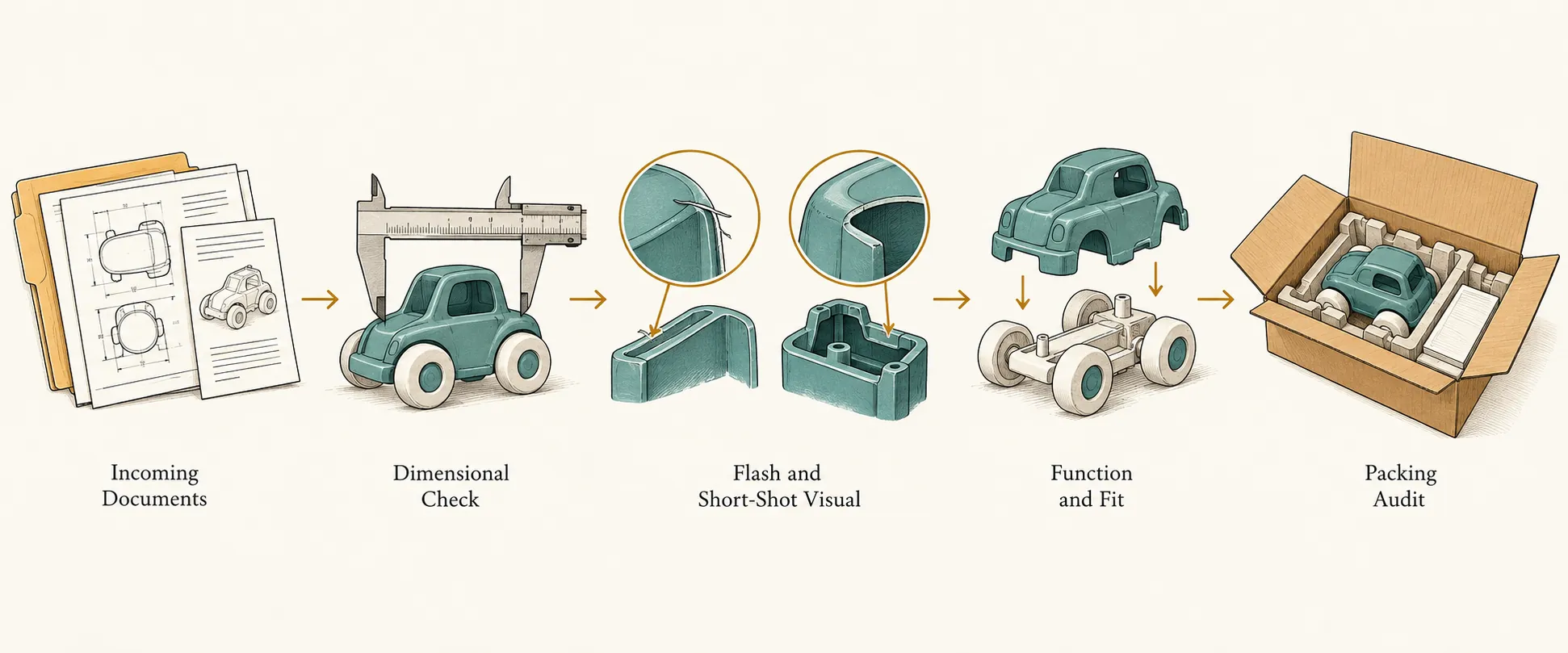
What can a product photo establish—and what needs other evidence?
A product photo can support visible identity and layout, but it cannot establish material composition, working performance, current stock or safety suitability.
Start with the play mechanism and assortment job. For a musical piano with light, request views identifying the controls, light features, housing and any power-access arrangement. Request a demonstration of the intended sound and light responses rather than treating a glowing catalog image as a function test. For a musical activity mat, identify the mat, musical component, attachment points and all included parts before deciding how it fits the assortment.
Keep the evidence types separate. The catalog supplies recorded material and packing descriptions. A current physical sample supports checks of feel, assembly and function. Artwork defines visual production instructions. An artwork proof does not establish physical color matching, assembled fit, packaging strength or laboratory results. Artwork Proof Approval Checklist
Give every requested image a stable reference and retain its filename, revision, supplier-stated model and capture date. Ask the supplier to identify whether it shows a catalog model, current base sample, decorated sample or final packaged sample. Linking the exact product identifier and photo reference helps avoid quoting a similar-looking substitute as the selected item.
| Overall and detail photographs | Check visible shape, controls, component arrangement, decoration and distinguishing features. Record whether the image shows the requested version. |
|---|---|
| Function demonstration | Request a video or sample check against a written function list. A still image does not demonstrate sound, movement or operating sequence. |
| Materials and included contents | Cross-reference a component-level material description and contents list. Do not infer the whole construction from one catalog material field. |
| Branding and packaging | Link the image to the exact artwork and packaging revisions. A blank sample does not establish final branding; a packaging PDF does not establish physical fit. |
| Age, destination documents and availability | Request SKU-specific confirmation and supporting documents. Product names, pictured users and catalog colors do not establish these matters. |
Musical Piano with Light: Product-Photo Identity Record
| Product identity | Product ID: . Catalog name: Musical Piano with Light. Status: confirmed from catalog. |
|---|---|
| Function and assortment role | Recorded description: musical piano with light. Proposed assortment role: music-and-light play. Status: catalog description confirmed; operating sequence and current sample performance to confirm. |
| Material | Recorded material: ABS. Status: confirmed from catalog. Request identification of the component or components covered by this description. |
| Packing | Recorded packing: color box. Status: confirmed from catalog. Request the current box revision, included contents and packed-product photographs. |
| Commercial identity | Reference MOQ: 120; recorded units per carton: 60. Status: confirmed from catalog only. Ask the quotation to define the sales unit, included-piece count and MOQ for the exact requested configuration separately. |
| Photo-to-field cross-reference | Request P01: overall front view for model identity; P02: rear and underside for construction and any power access; P03: controls and light-feature details; P04: all included contents beside the open box; P05: all package panels. Status: to confirm through the current photo set. |
| Next-step decision | Suitable for a scoped quote or sample inquiry using the catalog identity. Do not treat the record as approval of function, final color, logo, packaging, stock or production. |
Musical Lion Activity Mat: Product-Photo Identity Record
| Product identity | Product ID: . Catalog name: NEW Tummy Time Musical Lion Baby Gym Play Mat Activity Center for Infant. Status: confirmed from catalog snapshot dated October 9, 2026. |
|---|---|
| Function and assortment role | Recorded description: musical lion baby gym/play mat activity center. Proposed assortment role: activity-mat concept for buyer review. Status: catalog description confirmed; mechanism, assembly, intended user and age suitability to confirm. |
| Material | Recorded material: wooden. Status: confirmed from catalog. Request a component-level material list identifying exactly which parts this description covers. |
| Packing | Recorded packing: color box. Status: confirmed from catalog. Request the contents list, assembly arrangement, package revision and physical packing demonstration. |
| Commercial identity | Reference MOQ: 54; recorded units per carton: 18. Status: confirmed from catalog only. Confirm whether the quoted sales unit is the complete activity center and identify all included components. |
| Photo-to-field cross-reference | Request L01: complete assembled view; L02: every included component laid out; L03: musical component and controls; L04: attachments and component-material details; L05: packed arrangement and package panels. Status: to confirm through the current photo set. |
| Next-step decision | Release a clarification inquiry for contents, construction and function. Hold a configuration-comparable quote or internal product approval until the complete quoted unit is defined. |
How should color, logo and packaging be linked in one customization request?
Define customization as one linked configuration: product and sales unit first, then color acceptance, logo process and position, packaging, and the approved sample reference.
Choose an existing-color route when the supplier can identify an acceptable current variant. Choose custom color when a controlled brand match is required, and obtain its configuration-specific MOQ and sample route. Neither a catalog color nor an attractive photo establishes inventory or immediate shipment. Confirm opening-order availability and reorder conditions.
The following is an explicitly hypothetical request for the piano, not a supplier quotation or an approved project. Its proposed identifiers illustrate how the fields stay connected. A blank sample does not prove the final logo or retail package, and a packaging PDF does not prove physical fit. Custom Toy Sample Approval Checklist
| Request identity and revision | Hypothetical request H-Piano-01, revision A, dated October 28, 2026. Base product: the Musical Piano with Light identified in the piano record above. Attach the supplier-confirmed P01–P05 image set. |
|---|---|
| Product, quoted unit and quantity | Proposed quantity: 120 complete boxed pianos. Requested sales unit: one complete piano with its agreed included contents in one color box. Ask the supplier to enumerate the contents and confirm feasibility and the applicable MOQ; 120 is a request, not a confirmed custom-order minimum. |
| Color reference and tolerance | Target: housing color matched to buyer physical master C1. Proposed visual acceptance: the agreed finish must remain within buyer-approved light and dark limit swatches under the agreed viewing conditions. Record those conditions and swatch identities before approval. If numerical color control is needed, agree the measurement method and limit separately. |
| Logo location and process | Target: one-color logo on the front housing area identified in annotated image P01-L, using pad printing subject to supplier feasibility confirmation. The returned proof must dimension logo size and position from fixed housing edges and identify artwork file Logo-A. |
| Packaging artwork and wording | Target: color-box artwork Box-A on the supplier-confirmed dieline. Identify every panel, contents statement, barcode data, buyer-approved copy and destination-specific wording for review. Obtain file-format and bleed instructions from the actual printer. |
| Sample target versus observation | Target: one sample combining the requested housing color, logo and packed configuration. Record observations against each target when received, including function, color-limit comparison, logo placement and box fit. No physical observations are asserted in this hypothetical request. |
| Approval identity and decision | Buyer approver A owns the request dated October 28, 2026. Decision: release revision A for feasibility review and a scoped quotation only; production is not approved. |
| Open-condition owner and closure | Supplier project owner: return configuration MOQ, quote, dimensioned logo proof and package-fit proposal. Buyer approver A: accept or revise the returned scope. Close each condition with its evidence reference, actual closure date and updated record revision. |
Which commercial details must be confirmed before the next release?
Confirm the sales unit and requested configuration before comparing quotations; catalog MOQ and carton quantity are separate reference fields, not interchangeable order rules.
Compare base-color, custom-color, logo-only and custom-box proposals on the same contents and sales unit. Keep product price, decoration setup, sample or proof charges, packaging, testing or inspection scope, and carton assumptions separately identifiable. Do not transfer one configuration’s MOQ to another. Custom Toy Order Quantity Planning
For either example, request a dated quote with validity, sample type and cost, configuration-specific MOQ, availability, reorder conditions and a schedule tied to stated approvals. Confirm carton dimensions, gross weight, units per carton, shipment basis, destination and requested arrival date for that configuration. A carton count alone does not create a full-carton ordering restriction.
Record intended users, destination and the documents and package wording to be reviewed by the responsible buyer or compliance reviewer. Match any report to the relevant construction and scope; do not infer coverage from a similar product photo. These are purchasing controls, not a declaration that either example is certified or suitable for a particular age.
Who approves release, and how are later changes closed?
The named buyer approver releases only the stated next step against a specific record revision, with open conditions assigned to owners and closed against evidence.
Use “confirmed” only with a traceable basis: catalog entry, current photo, sample observation, accepted artwork or written commercial confirmation. Use “to confirm” with a direct action and owner. Reserve “not applicable” for an intentionally excluded feature or route, not an unanswered question.
Before production release, identify the approved physical sample where required, its date, the controlling product record, artwork and packaging revisions, and the agreed acceptance criteria. A signed sample does not itself define a numerical tolerance. Approval also does not prove every bulk unit will match; production QC and any agreed pre-shipment inspection remain separate controls.
Record changes to the product, material, color, components, branding process or packaging in a new revision. Identify the superseded reference and decide whether the change needs another proof, sample, quotation or compliance review. The record supports traceability; it cannot by itself reveal an undisclosed substitution.
| Release to quote request | Approve the identified base product and explicitly bounded requested configuration for pricing. List any provisional assumptions that must appear in the returned quotation. |
|---|---|
| Release to sample request | Approve the sample type and what it must demonstrate: base function, branding, color, packaging fit or the combined configuration. State which questions that sample will not resolve. |
| Release to internal or production approval | Record the approver’s name, decision date, controlling revision, specified targets, observations and accepted conditions. Hold the relevant release when a material condition remains unresolved. |
| Condition closure | For each open item, record the responsible owner, required evidence, agreed due date, actual closure date and accepting approver. Carry unresolved items into the next revision rather than deleting them. |
APPLY THE GUIDE
Build a quote around the order you plan to place.
Bring the product, destination, expected quantity and date into one brief.
Start a sourcing brief