No test report, certificate, or past approval grants permanent OEM toy development approval. In the US, the mandatory ASTM F963 version is tied to the date of manufacture — not the date of import or sale — so a report issued for one production run does not automatically cover the next batch. Toys manufactured after April 20, 2024 must meet ASTM F963-23, per CPSC guidanceCPSC Toy Safety Business Guidance. For OEM toy manufacturers in China and the buyers who work with them, the practical decision is this: treat every test date as a point-in-time record, confirm the applicable standard for each batch's manufacture date, and confirm package, MOQ, sample, and destination-document details at SKU level before you commit.
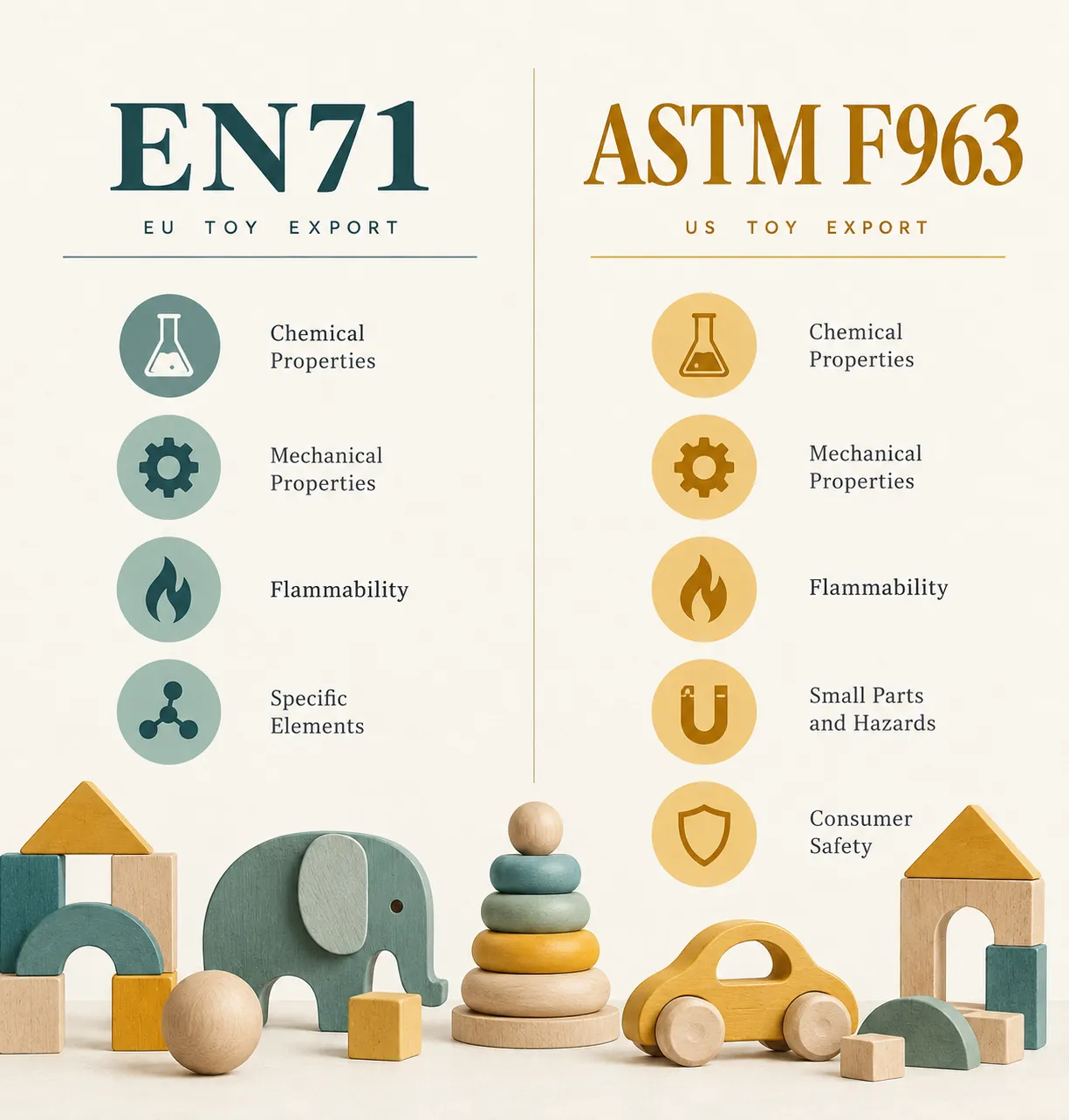
What a test date actually covers vs. what it does not
| What a dated test report supports | Evidence that the tested sample met the specified requirements at the time of testing |
|---|---|
| What it does not support | Permanent approval, automatic coverage of future batches, or immunity from recalls |
| Standard version trigger | Date of manufacture, not date of import or sale |
| Current mandatory version (US) | ASTM F963-23 for toys manufactured after April 20, 2024 |
| Age scope for CPSC testing and CPC | Toys primarily intended for children 12 or younger |
| Age scope for ASTM F963 | Children under 14 |
| Sections excluded from the mandatory requirement | ASTM F963 sections that restate existing CPSC or FDA requirements, such as section 4.2 Flammability and section 4.3.4 Cosmetics |
Why the date of manufacture decides which standard applies
Since 16 C.F.R. part 1250 is a consumer product safety standard under the CPSA, the effective date of any successor standard is tied to the date of manufacture, regardless of whether the product was manufactured outside the US. That single rule is the reason a test date cannot be treated as permanent approval: a report tied to an older standard version does not cover a batch made after a newer version took effect.
For US-bound children's toys, the current mandatory version is ASTM F963-23 for units manufactured after April 20, 2024. If your production run straddles a standard change, you need to know which units were made on which side of the effective date. That is a production-record question, not a paperwork question — and it is the one buyers most often skip.
Which age scope triggers third-party testing and a CPC
ASTM F963 covers products intended for children under 14, but CPSC testing and certification requirements apply only to products designed or intended primarily for children 12 years of age or younger. A toy aimed at a 13+ audience may still fall within ASTM F963's scope while sitting outside the third-party testing and Children's Product Certificate (CPC) requirements.
In practice, that boundary matters when a product line is marketed across age bands. If the same SKU is sold to both a 10-year-old and a 13-year-old audience, the conservative reading is to treat it as a children's product for 12 or younger and plan for testing and certification. Age grading is a marketing and design decision with regulatory consequences, so confirm it before tooling, not after.
What recent recalls show about test dates and scope
Two 2026 CPSC recalls illustrate how a dated record and a specific failure can diverge. TheKiddoSpace recalled children's Christmas tree play sets on February 26, 2026 after the zipper pull on the music box compartment was found to contain lead above the federal lead content ban, and the tree component failed mechanical and electrical requirements for battery-operated toysCPSC recall notice. The recalled sets were sold online from November 2023 through February 2025 at $13 to $40, imported by SN Commerce LLC, and manufactured in China.
Separately, Stoney Games recalled Kluster magnet chess games on March 12, 2026 because loose high-powered magnets fit within CPSC's small parts cylinder, posing an ingestion hazardCPSC recall notice. Those games were sold from October 2018 to September 2025 at $15 to $20. Neither recall implies anything about any other product or manufacturer; they are external examples of how a specific component or configuration can fail a requirement even when a product has been on the market for years.
How to build a per-batch approval worksheet
The worksheet that resolves this decision has four columns: batch, date of manufacture, applicable standard version, and evidence on file. For each production batch, record the manufacture date and confirm which ASTM F963 version applies to that date. Then check whether the evidence on file matches that version — not an earlier one.
Keep the worksheet at SKU level, not product-family level. A color change, a component swap, or a new battery configuration can move a product into a different requirement set. When the evidence does not match the batch, the correct action is to test the batch, not to rely on the older report.
What to confirm at SKU level before you commit
Catalog records establish what a product is; they do not establish certification, stock, or current commercial terms. For any SKU you are evaluating, confirm package format, reference MOQ, sample availability, destination-document requirements, and shipment details individually. A reference MOQ is a starting point for a quote, not a guaranteed order multiple, and a carton quantity is not automatically an order multiple unless the supplier states a full-carton restriction.
The same discipline applies to customization. A missing color or logo field in a catalog record does not prove a product cannot be customized — it means you need to request that detail in a quote. Ask directly: which colors are available, what is the custom-color MOQ, and what artwork format and bleed does the printer require? Those answers belong to the specific supplier and printer, not to a general rule.
Frequently asked questions
Does a passing test report give permanent OEM toy development approval?
No. A test report records that a sample met specified requirements at a point in time. It does not cover future batches, and the mandatory standard version is tied to the date of manufacture, so each production run needs to be checked against the standard in effect for that date.
Which ASTM F963 version applies to my order?
The version in effect on the date of manufacture. For US-bound children's toys manufactured after April 20, 2024, that is ASTM F963-23. Confirm the manufacture date for each batch, because the date of import or sale does not determine the applicable version.
Do all children's toys need third-party testing and a CPC?
CPSC testing and certification requirements apply to toys designed or intended primarily for children 12 years of age or younger. ASTM F963 covers children under 14, so a toy aimed at 13+ may fall within the standard's scope without triggering third-party testing or a CPC.
Do ASTM F963 sections that repeat CPSC or FDA rules count toward the mandatory toy requirement?
No. Under 16 C.F.R. § 1250.2(b), sections that restate or incorporate an existing mandatory standard, ban, statute, or regulation already enforced by the CPSC or FDA — such as section 4.2 Flammability and section 4.3.4 Cosmetics — are not part of the mandatory children's toy requirement under 16 C.F.R. part 1250.
Can I reuse an old test report for a new production batch?
Only if the report matches the standard version applicable to that batch's date of manufacture and the tested configuration matches the batch. If either differs, the report does not cover the batch and new testing is the appropriate step.
Sources
- Toy Safety Business Guidance | CPSC.gov
- TheKiddoSpace Recalls Children’s Christmas Tree Play Sets Due to Risk of Injury from Lead Exposure; Violates Federal Lea
- Stoney Games Recalls Kluster Magnet Chess Games Due to Risk of Serious Injury or Death from Magnet Ingestion; Violates M
Ready to confirm your OEM project details?
Send us your target SKU, destination market, and required standard version. We will confirm package, reference MOQ, sample, and destination-document details at SKU level so you can build an accurate approval worksheet before you commit to production.
APPLY THE GUIDE
Build a quote around the order you plan to place.
Bring the product, destination, expected quantity and date into one brief.
Start a sourcing brief