Ask for a committed delivery date for each named file revision—not a general promise to “update soon.” When working with OEM toy manufacturers in China, identify the current version, list the changes, state the required milestone, and request a named owner, delivery date, time zone, and dependencies. Record the supplier’s commitment separately from your requested date and your approval deadline. This gives the project schedule a specific deliverable to track without treating file delivery as approval.
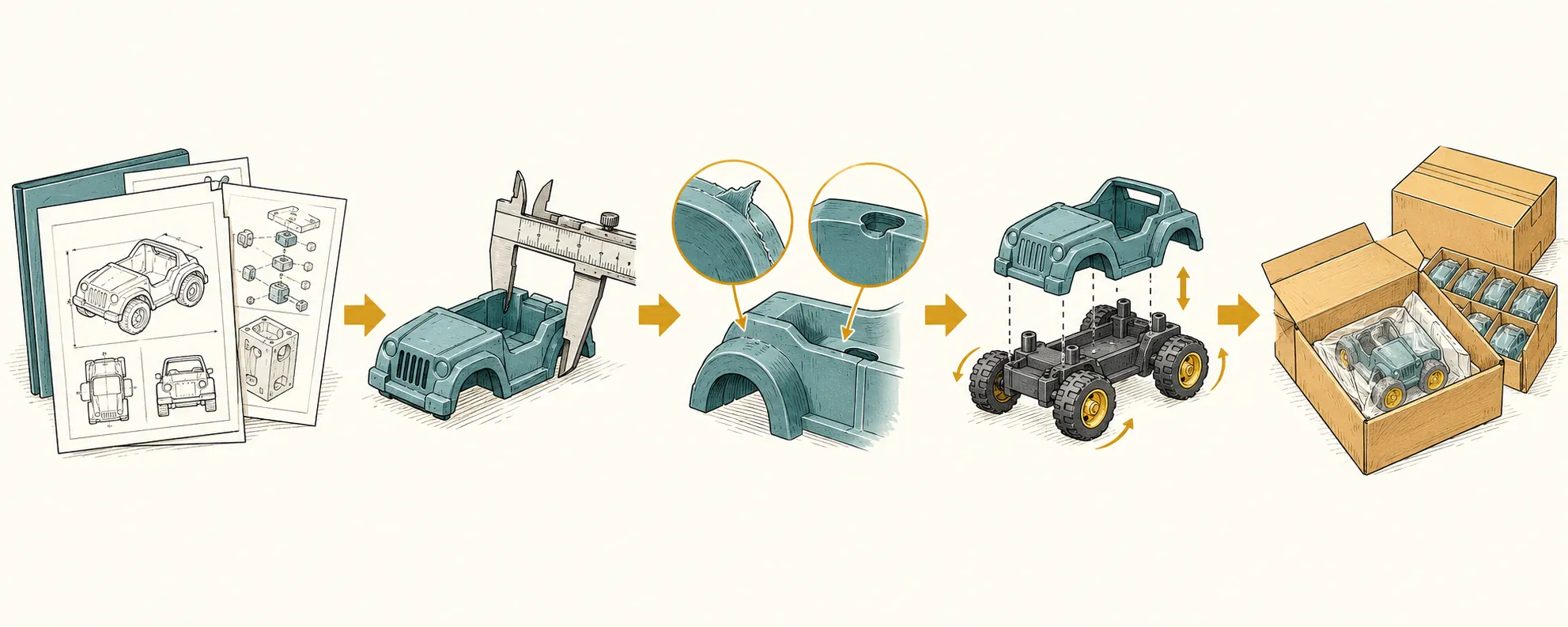
Which product file needs a revision date, and what is its current version?
Identify the exact file and baseline version before asking when the revision will be ready. Include the project reference, product configuration, file name, revision identifier, issue date, and a link or attachment to the version being changed. “Please revise the packaging” is not precise enough when several proofs are circulating.
Keep three dates distinct: the existing file’s issue date, the promised delivery date for its replacement, and the buyer’s approval deadline. A file’s modified timestamp is useful supporting information, but it is not a substitute for an agreed revision identifier or written commitment.
Send the request to the supplier’s project contact and ask that person to confirm the responsible designer, engineer, packaging coordinator, or sample coordinator. Keep one accountable contact for the response even when several people perform the work.
What changes are needed, and by when?
Define the revision as a bounded change against the current version, then connect its delivery date to the next review or approval milestone. Request separate dates for revised artwork, packaging layouts, and sample records when they have different owners or dependencies. Treat the schedule as linked approval milestones rather than one fixed turnaround period. Custom Toy Order Timeline
A magnetic steel ball drawing board illustrates why the scope matters: its recorded construction includes an ABS plastic case, magnetic board, metal marbles, and magnetic pen, with color-box packaging. A box-logo change and a physical case-color change therefore call for different evidence. Approving the box proof does not establish the physical color match or product function. Artwork Proof Checklist
How should a linked customization revision request be written?
Write one request that connects the agreed product configuration to the color, logo, packaging, sample, and change record. The following is an explicitly hypothetical buyer request; its dates and project references are illustrative, not supplier lead-time claims.
Subject: Project DRAW-A — confirm revision delivery dates for specification r03, packaging r04, and sample record r02.
Product and quoted unit: Please confirm that quote Q-A r02 covers one complete magnetic drawing board with its magnetic pen in one color box. List the included components explicitly. Keep the quoted sales unit, internal component count, carton quantity, and order quantity separate. Confirm availability and reorder conditions for the selected configuration; if custom color or packaging changes the MOQ, identify that constraint separately rather than carrying over the base-product MOQ.
Color and logo: Retain the case color represented by buyer-held physical master C1. Record the proposed numerical color tolerance and assessment method in specification r03 for buyer approval; a signed sample alone will not define that tolerance. Place logo artwork L2 on the front panel of the color box using the quoted box-printing process, with no direct printing on the toy. Confirm the process and show the position and dimensions on the proof.
Packaging and sample: Revise the color-box artwork against copy sheet T2, including the buyer/importer-required wording identified there, without unapproved substitutions. Reference existing sample S1 as the baseline, not as approval of the new color or artwork. Identify the replacement sample and its linked specification and packaging versions in the sample record.
Dates and responsibility: Please confirm by October 29, 2026, at 17:00 China Standard Time which owner will deliver each revised file. We request specification r03 by November 2, packaging r04 by November 4, and the replacement sample review record by November 9. For each file, state your committed delivery date, prerequisites, and the effect of any unmet prerequisite. Specify separately when the physical sample can be dispatched and received; delivery of its record is not delivery of the sample.
Change control: Record these changes under CR-A. Return a marked-up comparison and a clean revision. Do not treat receipt of either file as production approval; identify the exact versions and sample requiring buyer sign-off.
What should a completed revision-date worksheet record?
| Product specification — DRAW-A_spec_r02.pdf → r03 | Current version: r02, issued October 27, 2026. Requested revision: record physical color master C1, proposed numerical tolerance and assessment method, and the agreed product configuration under CR-A. Requested delivery: November 2. Supplier-agreed delivery: November 3, 17:00 China Standard Time. Responsible party: supplier product engineer, coordinated by the supplier project lead. Condition: buyer confirms the proposed color assessment criteria by October 30. Actual observation: r03 received November 3 with the agreed criteria and configuration recorded. Buyer approver/date: sourcing lead, November 4. Decision: approved for replacement-sample preparation, not production. Follow-up closure: supplier acknowledged r03 as the working specification on November 4. |
|---|---|
| Color-box artwork — DRAW-A_box_r03.pdf → r04 | Current version: r03, issued October 27, 2026. Requested revision: apply logo L2 to the front panel, show its position and dimensions, and incorporate copy sheet T2 without other changes. Requested delivery: November 4. Supplier-agreed delivery: November 4, 17:00 China Standard Time. Responsible party: supplier packaging designer. Condition: buyer supplies final L2 and T2 by October 30. Actual observation: r04 received November 4; buyer found one omitted line from T2. Buyer approver/date: packaging lead, November 5. Decision: revise; r04 not approved. Follow-up closure: corrected r05 received and approved November 6; supplier acknowledged that r05 supersedes r04. |
| Sample review record — DRAW-A_sample_r01.pdf → r02 | Current version: r01, linked to baseline sample S1. Requested revision: identify replacement sample S2, link specification r03 and box artwork r05, and record observations against the agreed targets. Requested delivery: November 9. Supplier-agreed delivery: November 10, 17:00 China Standard Time. Responsible party: supplier sample coordinator. Condition: final artwork approved and physical sample received for buyer review. Actual observation: S2 received November 9; completed r02 received November 10 and reviewed against the agreed targets. Buyer approver/date: product lead, November 11. Decision: S2 and its linked versions approved as production references; production release remains a separate authorization. Follow-up closure: supplier acknowledged the approved reference set on November 11. |
What date can the supplier commit to, and under what conditions?
Accept a schedule commitment only when it identifies the deliverable, owner, date, time zone, and prerequisites. “Next week” needs a specific date. “Three days after approval” needs the approval input, its cutoff, and confirmation of whether those are working or calendar days. “Artwork Friday” needs clarification about whether that means a first proof, corrected proof, or production-ready file.
Ask directly: “Can you commit to this revision date against the attached baseline and change list? If not, provide your earliest achievable date, the blocking input, its owner and deadline, and which downstream milestone would move.”
A later date with explicit dependencies is more useful for planning than an earlier date that does not identify what will be delivered. Keep a conditional commitment marked as conditional until its prerequisite is satisfied; do not silently replace the buyer’s requested date with the supplier’s response.
How is the agreed revision date integrated into the project schedule?
Enter the agreed delivery date against the individual file task, then schedule buyer review and approval as separate activities. Link dependent work to the necessary approval—not merely to the date a file arrives.
When the revision arrives, record its actual receipt date and compare the delivered version with the requested changes. The approval record should identify the exact artwork version, placement, colors, text, and package layout being accepted. A proof controls visual instructions; it does not replace physical or functional checks. Artwork Proof Checklist
If a date slips, retain the original commitment and add the revised forecast, reason, responsible owner, and affected milestone. Request a recovery action and a new confirmation date. If the revision scope changes after approval, issue a new change record and determine whether another proof, sample, quotation, or schedule review is needed. Identify which version replaces the earlier approval. Artwork Proof Checklist
Close the task only after the buyer’s decision is recorded and the supplier acknowledges the controlling version and any remaining conditions. This creates traceability; the record alone does not verify that production followed the approved files.
APPLY THE GUIDE
Build a quote around the order you plan to place.
Bring the product, destination, expected quantity and date into one brief.
Start a sourcing brief