Define an unchanged base SKU by freezing the toy’s play function, mechanism, materials and component set against an identified specification and sample—not merely its catalog number. For a picture-matching game with geometric blocks, preserve the matching function and agreed block assortment while approving branding and packaging separately. When working with OEM toy manufacturers in China, obtain written confirmation of that frozen core before approving customization, and assign each permitted change its own revision and acceptance criteria.
The practical distinction is between an unchanged base product and an unchanged finished configuration. A new printed box can retain the same toy core while creating a different finished configuration. A substituted block, material or mechanism cannot be treated as unchanged simply because the supplier keeps the original catalog number.
Which Fields Belong to the Frozen Toy Core?
Freeze the fields that determine what the toy is and how it works; authorize decorative and packaging changes only within a separately defined scope.
The core specification should identify the operating mechanism, intended play function, component geometry and quantities, materials by component, assembly interfaces, and agreed dimensions or fit requirements. Record material at component level: a catalog entry stating ABS does not establish the composition of every part.
Color, logo and theme are not automatically unrestricted. A printed theme can be a customization layer; a themed replacement component changes the component specification. An accessory can remain outside the frozen core only when it is separately listed and does not replace a core part or alter the agreed play function.
Treat unit packing as a configuration field. Keeping a color box while changing its artwork is different from replacing the box, changing the included assortment or combining several toys into one sales unit.
Which Catalog Reference Should Anchor the Freeze Record?
| Educational Elephant Picture Matching Game | Catalog ID: . Recorded product: picture-matching game with geometric matching blocks. Recorded material description: ABS plastic with geometric matching blocks. Packing: color box. Reference MOQ: 108 catalog units. Units per carton: 36. Buying consequence: anchor the freeze to the matching function and a supplier-confirmed component list; have the quotation define exactly what one complete sales unit contains. |
|---|---|
| Hungry Wolf Eats Beans (Christmas) | Catalog ID: . Recorded material: ABS. Packing: color box. Reference MOQ: 180 catalog units. Units per carton: 60. Buying consequence: obtain a function demonstration and counted contents list before defining the base. Specify whether the Christmas treatment is printed decoration, included components or both; do not assume removing the theme leaves the same core. |
How Should Existing Color, Logo and Packaging Routes Be Compared?
Request separate quotations for the same complete toy configuration, changing only the customization layer being evaluated.
For the existing-color route, request available color references, current availability and reorder conditions. Catalog presentation is not an inventory commitment. For a custom color, identify the affected components and request that color run’s quantity constraint, sample route and acceptance method separately.
For branding, define the artwork revision, location, dimensions and application process. For packaging, distinguish artwork-only replacement from a new box structure or sales-unit configuration. Ask which requested operation creates a minimum quantity: product production, color, decoration or packaging printing can impose different constraints. Do not carry the catalog’s base MOQ into a custom-color or printed-box quotation. Custom Toy Order Quantity Planning
Keep product ID, quoted sales unit, pieces per set, units per carton and MOQ in separate fields. A carton count is not an order multiple unless the quotation explicitly makes it one.
What Should a Base-SKU Freeze Worksheet Contain?
| Project identity and revision | Frozen — Proposed project MATCH-01; freeze record F-01, revision 0. Base catalog ID: . Keep the base reference distinct from the customized finished-item identifier. Evidence: supplier acknowledgment of F-01. |
|---|---|
| Product and quoted sales unit | Confirm, then freeze — Quote one complete elephant picture-matching game in one color box as the proposed sales unit. List all included parts and quantities; do not equate one game with one individual block. Evidence: quotation Q-01 and itemized contents list B-01. |
| Play function | Frozen — Retain the picture-matching function using the agreed geometric matching blocks. No substitution of a different game activity. Evidence: specification S-01 and identified base sample E-BASE-01. |
| Mechanism and component set | Confirm, then freeze — Supplier to describe operation, identify every component and provide a counted contents photograph. Freeze the reconciled assembly and quantities in B-01; no substitutions or omitted parts. Evidence: B-01, function demonstration and E-BASE-01. |
| Materials by component | Confirm, then freeze — Start from the recorded ABS description; request a component-by-component material schedule. No material substitutions after approval. Evidence: material schedule M-01 linked to B-01. |
| Dimensions and fit | Confirm, then freeze — Supplier to identify relevant product and component dimensions, units and proposed acceptance limits. Record the approved targets separately from sample measurements. Evidence: dimension sheet D-01 and sample review R-01. |
| Molded color reference and tolerance | Confirm, then freeze — Retain the existing molded-color arrangement. Establish physical color master CM-01 and buyer-approved boundary samples for acceptable variation, with comparison lighting recorded in C-01. No recoloring is authorized. Evidence: signed color sheet C-01; numerical tolerance applies only if expressly agreed. |
| Logo location and process | Variable — Proposed scope: one-color pad-printed logo on the elephant body, subject to supplier confirmation of a suitable print area. Position and dimensions must follow drawing L-01, revision 1. No change to molded geometry. Evidence: supplier process confirmation, approved drawing and branded sample. |
| Unit packing format | Frozen — Retain one complete game per color box. Have the supplier confirm box structure, internal arrangement and fit against the approved contents. Evidence: packing specification P-01 and packed sample. |
| Packaging artwork and wording | Variable — Replace graphics only on the confirmed box structure. Approve artwork revision P-ART-01, including product description, contents, instructions, barcode placement and the exact destination wording agreed through product-specific review. Evidence: approved dieline proof and wording sign-off. |
| Accessories and theme | Frozen — No added, removed or substituted accessories; retain the elephant theme. Any later accessory or theme request requires a separate impact decision. Evidence: B-01 and customization scope F-01. |
| MOQ and customization constraints | Confirm — Catalog base reference: 108 units. Request the current MOQ for this exact quoted configuration and identify any separate pad-printing or packaging-printing minimum. Evidence: Q-01; do not treat the base reference as a customization commitment. |
| Carton configuration | Confirm — Catalog reference: 36 units per carton. Request the packed configuration for the approved box and confirmation of any full-carton ordering restriction. Evidence: packing specification P-01 and Q-01. |
| Availability, reorder and sample route | Confirm — Request current base-product availability, repeat-order color and component conditions, the base-sample route and the branded/packed sample route. Evidence: written supplier response linked to Q-01 and the approval schedule. |
What Approval Sequence Confirms the Base Before Customization?
Confirm and sign the base specification first, approve the affected customization layers next, and release production only against the reconciled final configuration.
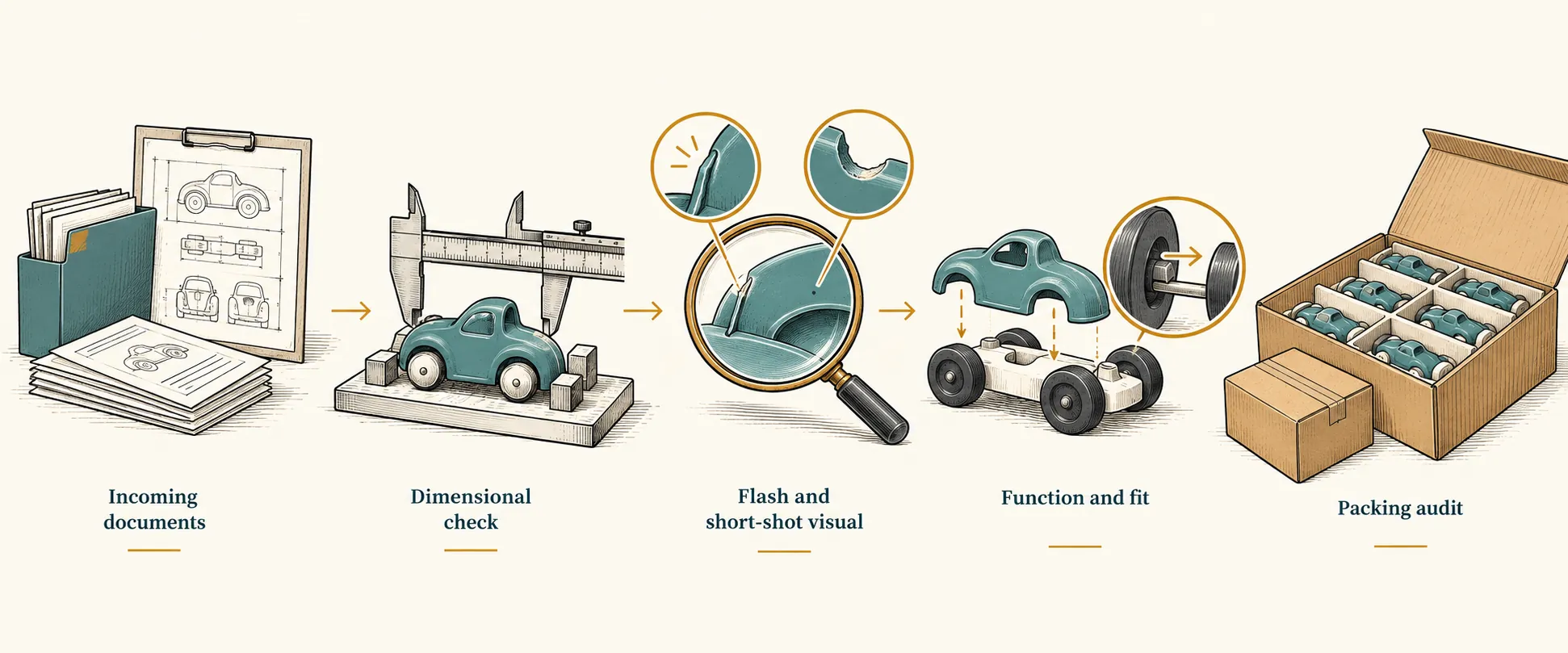
Start with supplier inquiry while defining scope. Obtain the component list, material schedule, quoted unit and base evidence; then compare the sample with each frozen target. Record observations rather than a blanket “sample approved”: component counts, function findings, measured dimensions and any deviations should have identifiable references.
Once both parties have signed the base confirmation, approve logo and packaging proofs against their own revisions. Review a physical branded or packed sample wherever appearance, application, fit or function cannot be established by artwork alone. This staged approach is consistent with the separation of product, artwork, sample, packaging and production approvals in supplier planning guidance. Custom Toy Order Quantity Planning
Before production release, request sample evidence and destination documents appropriate to the exact construction, intended user and market. The base-freeze signature is a purchasing control, not a safety certification. A signed sample also does not create a numerical color or dimensional tolerance.
What Must the Signed Base-SKU Confirmation Note Record?
| Identity and evidence | Record the project, base catalog reference, finished configuration reference, freeze-record revision, specification and BOM revisions, and unique sample identifiers. Attach dated photographs and the relevant review records. |
|---|---|
| Specified target versus observation | For each frozen field, show the approved target beside the observed result or referenced inspection record. Identify any difference precisely rather than relying on an overall sample signature. |
| Supplier confirmation statement | Signing text: “We confirm that the base product identified in this record matches the listed frozen specification, except for deviations expressly listed here. Only the recorded variable layers are authorized for customization. Proposed changes to frozen fields require written buyer reapproval.” |
| Decision and conditions | Buyer to select approved, approved subject to listed conditions, or not approved. State which next activity is authorized and which remains on hold. Record each condition, its owner and the evidence needed to close it. |
| Responsible approvers and dates | Record the supplier representative’s name, role, signature and date, plus the responsible buyer approver’s name, role, signature and date. Obtain specialist review where the buyer’s approval responsibilities require it. |
| Follow-up closure and production release | For every condition, record corrective evidence, closure decision, responsible approver and closure date. Link production release to the final base record, customization revisions and approved sample configuration. |
When Does a Change Require a New Base Revision or Sample?
A change to mechanism, material, component geometry, component set or play function invalidates the unchanged-base description and requires a new controlled base revision.
The supplier need not assign a new catalog number for the buyer to recognize a changed base. Give the revised construction a distinct project reference, identify what changed, and decide the required sample, document review, quotation and schedule updates before authorizing work.
Artwork-only changes can retain the frozen core, but reapprove the affected proof. A new logo process may require a physical branded sample; a replacement box structure requires a packing-fit review. Changes to color, components, branding method or packaging should trigger an explicit decision about new proofs, samples, document review, quotation or timing—not an automatic restart of every approval. Custom Toy Order Timeline
A multipack is a distinct finished configuration even when its individual toys retain the same frozen cores. Define the bill of materials, quantity of each item, assortment and final packing before comparing its quotation with a single-game configuration. Custom Toy Order Quantity Planning
Keep the decision simple: preserve the core and approve the layer, or revise the core and approve a new baseline. The record supports traceability; it does not by itself detect an undisclosed substitution, so production checks must still compare the supplied goods with the approved specification.
APPLY THE GUIDE
Build a quote around the order you plan to place.
Bring the product, destination, expected quantity and date into one brief.
Start a sourcing brief