Choose an immediate reorder when the last approved sample, packaging and destination documents are unchanged, and confirm the current quote, MOQ and carton quantity at SKU level before releasing the PO. Choose a new sample round when anything the buyer will see or the regulator will test has moved: color, logo, packaging artwork, material, mechanism, or the destination market. For toy sample development, that single test usually settles the question.
Two catalog records show why the answer is SKU-specific. , the Educational Elephant Picture Matching Game, is recorded with eco-friendly ABS plastic and geometric matching blocks, a color box, a reference MOQ of 108 and 36 units per carton. , Hungry Wolf Eats Beans (Christmas), is recorded in ABS, a colour box, a reference MOQ of 180 and 60 units per carton. Those are catalog records, not stock, price or lead-time promises.
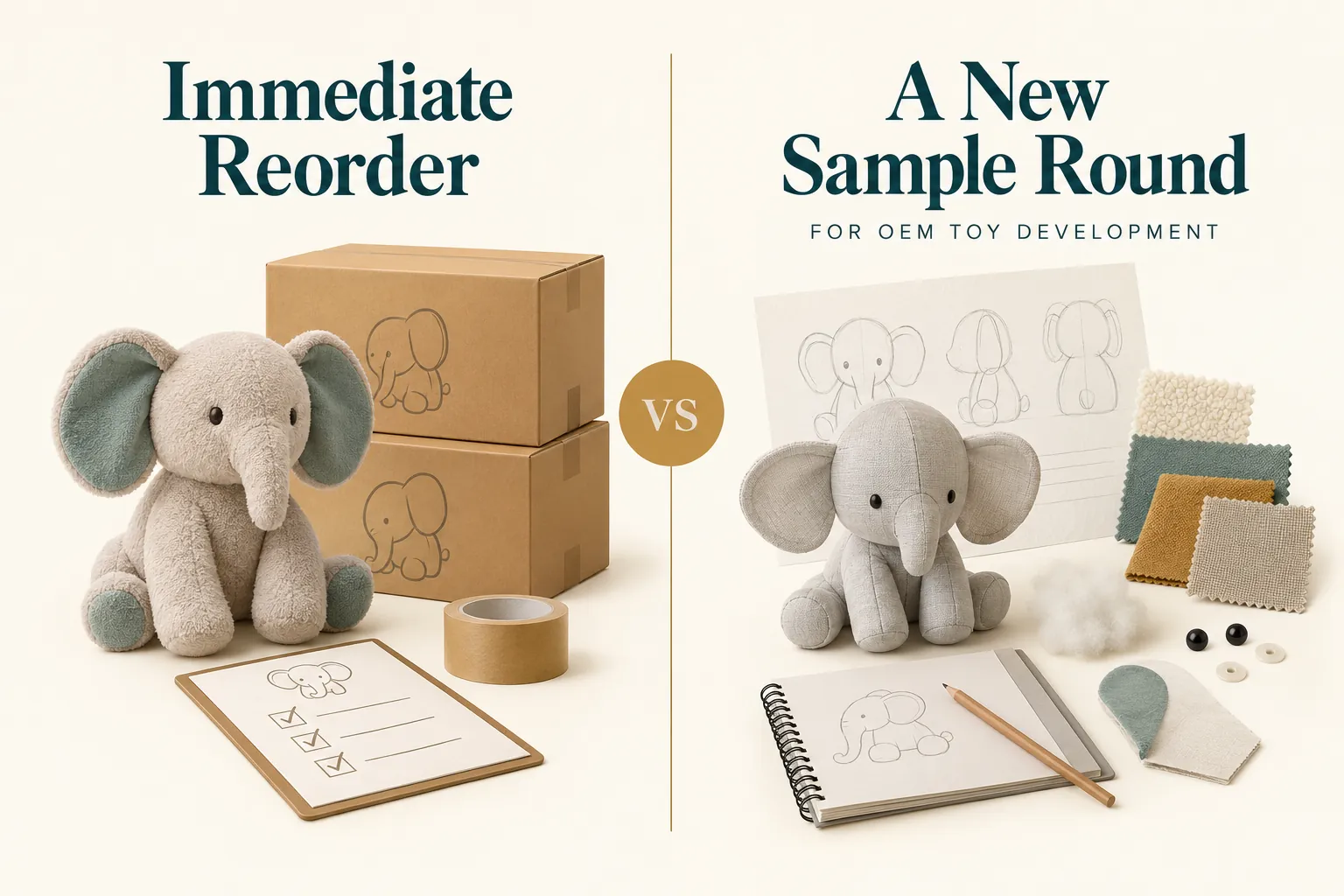
Immediate reorder vs a new sample round: what changes and what it costs you
| When it is the right call | Reorder: approved sample, packaging and destination documents are unchanged. New sample round: any visible, structural or regulatory input has changed. |
|---|---|
| What you must reconfirm in writing | Reorder: current quote, reference MOQ, carton quantity and shipping window for that SKU. New sample round: sample fee, refund condition, sampling time and the approval criteria for the first sample. |
| Commercial unit to compare | Keep the quoted sales unit, set piece count, carton count and MOQ independent. Do not convert a set quote into a per-piece price or a base MOQ into a custom-color MOQ. |
| (Educational Elephant Picture Matching Game) | Recorded material: eco-friendly ABS plastic with geometric matching blocks. Packing: color box. Reference MOQ 108; 36 units per carton. Reconfirm sample, current quote, age evidence and destination documents. |
| (Hungry Wolf Eats Beans, Christmas) | Recorded material: ABS. Packing: colour box. Reference MOQ 180; 60 units per carton. Reconfirm sample, current quote, age evidence and destination documents. |
| Main risk if you skip the sample | A color, logo or packaging change ships without buyer sign-off, and the destination documents may no longer match the goods. |
| Main risk if you resample unnecessarily | You spend sample time and fee on a product whose approved sample, packaging and documents have not changed. |
What the two catalog records actually tell you
is a picture-matching game built around geometric blocks in eco-friendly ABS plastic, packed in a color box. Its assortment role is early learning and matching play, which usually means the buyer cares about piece count, color consistency and box artwork. is a Christmas-themed ABS game in a colour box, so its role is seasonal gifting, where the packaging date and the shipping window matter more than the mechanism.
Neither record proves stock, current price, lead time, safe age or certification. Treat the recorded material, packing, reference MOQ and units per carton as the starting point for a quote request, and ask for the current specification sheet for the exact SKU before you commit.
How to run the reorder-versus-resample decision in one meeting
Put the last approved sample, the current packaging artwork and the destination document set on the table. If all three match what you are about to order, the reorder path is open. If any one of them has moved, open a sample round. That is the whole test, and it takes less time than debating it.
When you do open a sample round, agree the approval criteria before the sample is made. State the color reference, the logo placement, the packaging format and the destination market in the sample request, so the first sample is judged against a written standard rather than a memory.
Sample-round terms you should get in writing
Sample fees, refund conditions and sampling times vary by supplier and by product. One OEM plush supplier listing states a sample fee of generally 200-300 RMB, refundable when bulk quantity reaches 500 pcs, and a sampling time of about 3-5 days after the sample fee is paid; the same listing also states 200-500 RMB depending on shape and size, and a separate line gives 5-7 working days. Those are that supplier's stated terms, not standard OEM terms, and they are not evidence about any ToyOEMChina SKU.
The same listing describes two sampling routes: sampling from a customer image or PDF/AI design file, or sampling from a customer's physical sample using market-available fabric, with possible color and fabric-style differences. That fork is useful as a question to ask any supplier, including on hard-plastic and educational toys: do you sample from my file, or from my physical sample, and what will differ in the second case?
It also states a 30% deposit before bulk production and the remaining 70% after bulk inspection passes, described as negotiable. Whether that split suits your cash flow is a commercial decision; the point is to have the deposit, the balance trigger and the inspection acceptance criteria in the same written document before bulk starts.
Safety and compliance claims need item-specific evidence
The same supplier listing claims its products use eco-friendly materials and meet European and US safety standards for colorfastness, tensile strength, flame retardancy, azo content and needle/sharp-object detection. That is the supplier's own claim; the page provides no test report, certificate number or standard name. Treat it as a claim to verify, not as certification.
For any SKU you reorder or resample, ask for the test report or certificate number that covers the exact item and the exact destination market. A missing document does not prove a supplier is dishonest, but it does mean you cannot rely on the claim in your own compliance file.
Buyer questions on reorder and sample rounds
Can I reorder without a new sample if I only change the carton quantity?
A carton quantity change is a packaging change, so confirm it in writing before releasing the order. The recorded reference MOQ is 108 and the recorded carton quantity is 36 units; a carton quantity is not automatically an order multiple, and a reference MOQ is not a custom-packaging MOQ. Ask for the current quote and the packaging specification for the exact configuration you want.
Does the recorded MOQ of 108 for apply to a custom color or logo?
No. A base reference MOQ and a customization MOQ are separate figures. Ask for the customization MOQ and any tooling or setup cost for the specific color or logo change, and keep that number apart from the base order quantity.
How long does a new sample round take?
It varies by product, change and supplier. One OEM plush supplier listing states about 3-5 days after the sample fee is paid, and another line on the same page states 5-7 working days. Those are that supplier's stated terms, not a standard. Get the sampling time for your exact SKU in writing before you pay the sample fee.
Do listed colors mean the product is in stock?
No. A catalog color or a color shown in a photo does not establish stock availability or immediate shipment. Confirm availability and reorder conditions for the exact SKU and color before you plan a shipment date.
What should I ask for before approving a reorder?
Ask for the current quote, the reference MOQ, the carton quantity, the shipping window and the destination document set for that SKU, plus the test report or certificate number covering the item and the market you are shipping to. If any of those has changed since the last approved sample, treat it as a new sample round.
Sources
Send the SKU and the change, and we will quote the route
ToyOEMChina works with buyers on OEM and ODM toy projects across Build & Discover, RC & Vehicles, Outdoor & Water Play, Games & Learning Toys, Baby & Toddler, and Sensory & Novelty. If you are deciding between a reorder and a new sample round, send the SKU, the change you are considering and the destination market, and we will confirm the sample, packaging, MOQ and document questions at SKU level before you commit.
APPLY THE GUIDE
Build a quote around the order you plan to place.
Bring the product, destination, expected quantity and date into one brief.
Start a sourcing brief