Use revision-controlled specifications and sample approvals to govern OEM toy development; use consistent product photos to identify and communicate the appearance under review. For a musical lion activity mat, a photo can communicate layout but cannot demonstrate musical operation or establish which component is wooden. For a magnetic fishing game, an attractive set image does not establish magnetic performance or a complete 72-piece assortment. The practical decision is to approve named attributes against named references—not approve the latest image.
Photo consistency and revision control are complementary, not competing production routes. A photo records a view. A revision record connects that view to the product configuration, requested changes, review findings and release decision.
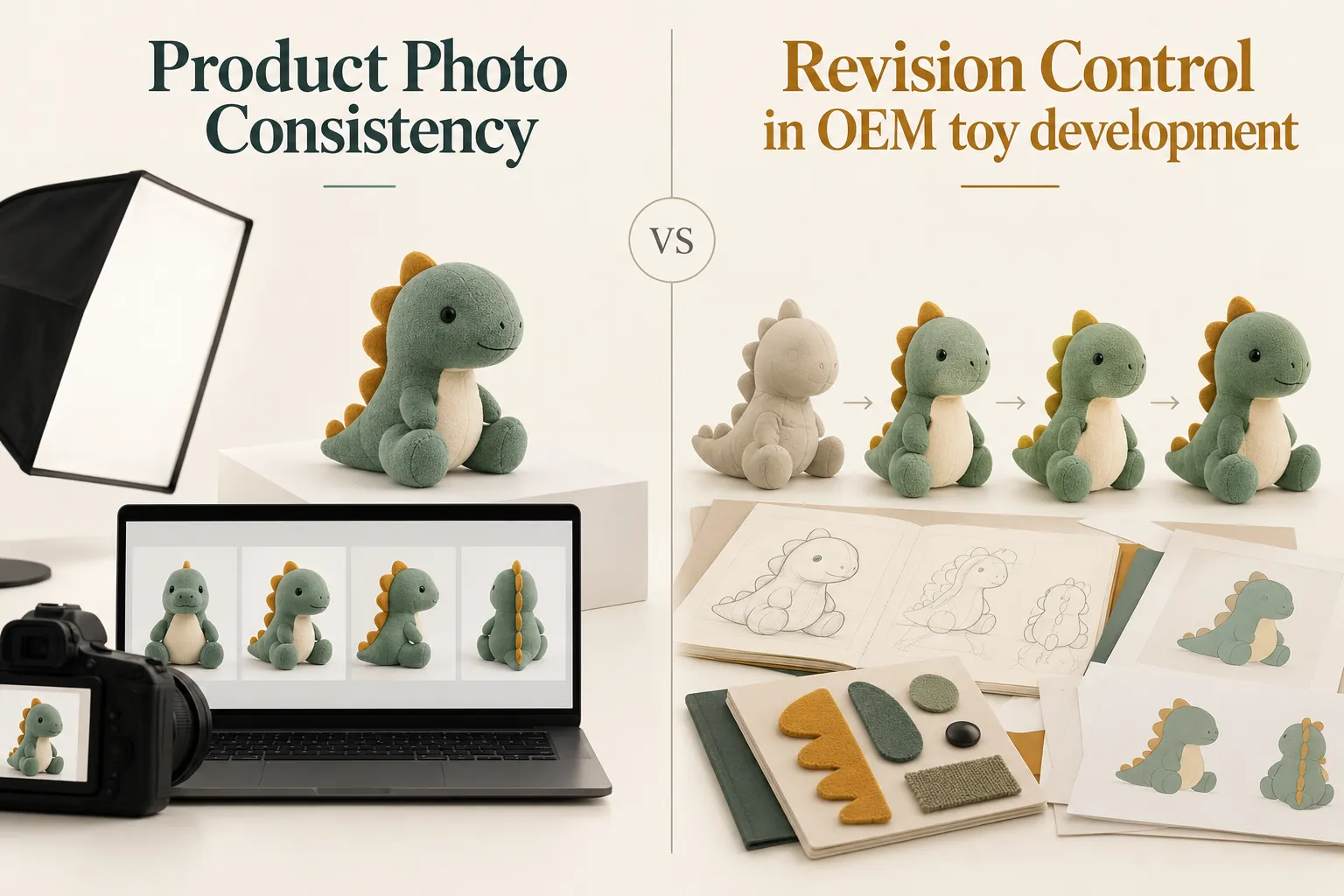
Which buyer decisions can photos and revision records control?
| Early assortment selection | Photos: support comparison of visible theme, arrangement and presentation. Revision record: identifies the exact configuration selected for quotation and sampling. |
|---|---|
| Color and surface appearance | Photos: communicate the intended appearance. Revision record: names the agreed physical color or finish reference and records the buyer's observations. Use consistent lighting, background and views as a practical comparison method. |
| Material and construction | Photos: show visible surfaces, not a complete material specification. Revision record: links component-level material targets to the reviewed sample and supporting checks. |
| Function and assortment contents | Photos: identify visible parts and their arrangement. Revision record: captures the agreed function check, itemized contents and actual findings. |
| Logo and packaging | Photos or proofs: support a scoped artwork review. Revision record: identifies the artwork version, print position, package configuration and separate approval status. |
| Next-stage release | Photos: serve as referenced attachments. Revision record: states the approved scope, remaining conditions, responsible approver and decision date. A newer file is not automatically an approved file. |
How do the musical activity mat and magnetic fishing game change the review?
| Product identity | Musical lion baby gym/play mat: . Magnetic Fishing Game 72PCS: . |
|---|---|
| Catalog-described play format | Musical lion activity mat: activity-center format with a musical feature named in the listing. Fishing game: magnetic fishing rod and accessories, with 72 pieces named in the listing. Confirm actual operation on the controlled sample. |
| Recorded material | Activity mat: Wooden. Ask which component this describes; do not treat it as the complete construction of the mat. Fishing game: ABS plastic with magnetic fishing rod and accessories. Record materials by component rather than treating the listing as a chemical-safety conclusion. |
| Recorded unit packaging | Both entries specify a color box. That identifies a packaging type, not approved artwork, box dimensions, insert design or pack-out. |
| Reference MOQ | Activity mat: 54 catalog units. Fishing game: 216 catalog units. Reconfirm the sales-unit definition and current MOQ for each exact configuration; neither figure establishes a custom-color or custom-packaging MOQ. |
| Recorded carton quantity | Activity mat: 18 units per carton. Fishing game: 72 units per carton. Carton quantity is separate from MOQ and does not, by itself, establish an order multiple. |
| Piece count versus commercial quantity | For the fishing game, 72PCS describes the listed product assortment; 72 units per carton is a separate packing field. Request an itemized contents list and confirm what one quoted sales unit contains. |
| Buying consequence | Select the activity mat for an activity-center assortment review and the fishing game for a magnetic-game assortment review. Do not approve either product's intended age, material suitability or destination requirements from its name or photo. |
What changes when the buyer requests color, logo or packaging customization?
Quote each customization against the same named base product and sales unit, then assign a separate revision to the changed appearance or packaging.
For an unchanged catalog configuration, request the available colors, quantity available, replenishment conditions and confirmation that the proposed shipment matches the selected reference. A pictured color is not an inventory commitment.
For a custom color, request a physical color reference and the MOQ for that configuration. For a logo, specify its position, dimensions and artwork version. For private-label packaging, identify the box artwork, contents arrangement and package revision. Do not carry either catalog MOQ into these requests as an assumed customization minimum: configuration changes can have different quantity constraints. Custom Toy Order Quantity Planning
Keep the comparison honest: a standard color-box configuration and a custom printed box are different quotations, even when the toy inside is unchanged. Record accepted changes explicitly; leave the unaffected product attributes locked to their previously approved references.
Musical Lion Activity Mat: Photo and Revision Review Worksheet
| Product identity and baseline | ; musical lion baby gym/play mat; catalog baseline dated October 9, 2026. Preserve this identity on the sample request, photo attachments and quotation. |
|---|---|
| Photo reference ID and date | Request a dated photo set carrying the sample's revision ID. Include an overall view, relevant component views and the proposed box. Record each attachment's ID and capture date. |
| Sample revision and date | Require the supplier to identify the physical sample revision and sample date. Link any component specification and correction request to that same revision. |
| Specified target versus observation | Target: the selected lion activity-center configuration, an identified wooden component and agreed musical operation. Observation: enter the component identification, actual sample appearance and function-check result separately; request correction wherever the result differs from the target. |
| Appearance control | Use the buyer-accepted, dated photo set to identify layout and visible details. Use the agreed physical reference for color and finish decisions rather than relying solely on a screen image. |
| Approval status and attributes to preserve | Initial decision: proceed to sample review only. After review, list each approved attribute with its controlling reference. In later revisions, preserve those attributes unless the buyer explicitly reopens them. |
| Packaging status | Request the color-box proof and physical packing configuration. Decide artwork and pack-out separately from product appearance and musical operation. |
| Controlling reference and open conditions | For production approval, name the accepted sample revision and matching written specification. Before order release, confirm the current quotation, sales unit, availability, reorder conditions, intended-age evidence and destination-document scope. |
| Responsible approver, date and closure | Record the buyer's named product approver and decision date. Assign each correction to a named supplier contact with an agreed due date; close it only after recording the evidence reviewed, closure decision, approver and date. |
Magnetic Fishing Game: Photo and Revision Review Worksheet
| Product identity and baseline | ; Magnetic Fishing Game 72PCS; catalog baseline dated October 9, 2026. Keep product identity, set contents and quoted sales unit as separate entries. |
|---|---|
| Photo reference ID and date | Request a dated overall image, an itemized contents view and relevant rod/accessory details. Record attachment IDs and link them to the photographed sample revision. |
| Sample revision and date | Require a sample revision ID and date matching the component list and correction request. Do not identify the production reference merely as the latest sample. |
| Specified target versus observation | Target: the agreed 72-piece contents list, identified ABS components and agreed magnetic fishing operation. Observation: enter actual quantities by component, material-identification findings and the functional result against the agreed review method. |
| Appearance control | Use the accepted photo set for visible assortment, decoration and layout references. Record any agreed color reference separately. |
| Approval status and attributes to preserve | Initial decision: proceed to sample and contents review only. Once reviewed, lock the accepted contents list, appearance and functional configuration to their named references; reopen only the attributes affected by an authorized change. |
| Packaging status | Request a color-box proof and a packing sample showing the agreed contents arrangement. Product approval does not release unapproved packaging. |
| Controlling reference and open conditions | For production approval, name the accepted sample revision, itemized contents list and written specification. Confirm current quote, sales-unit definition, customization conditions, availability, reorder terms, intended-age evidence and destination-document scope before order release. |
| Responsible approver, date and closure | Enter the named buyer approver and decision date. Give each contents, function or packaging correction an owner and agreed due date; record the replacement evidence and signed closure before releasing the affected stage. |
How should the buyer approve a revision and issue the handoff note?
Approve the next stage only against an identified revision, with separate decisions for product appearance, function, branding and packaging.
Start with visual alignment, then review the physical sample against both the written correction request and the last approved attributes. If a logo correction also changes an accepted color or component, reopen that changed attribute explicitly. Newest does not mean approved. This comparison method is also recommended in the Custom Toy Sample Feedback Form.
Keep the release narrow. Product approval can stand while box artwork remains under correction, provided the handoff clearly withholds the packaging stage. A revision record supports traceability; it does not itself detect an undisclosed material substitution. Likewise, a reviewed sample does not establish bulk-production consistency, final carton packing or every destination requirement.
Use this handoff wording after entering the actual review results: “For [product identity], [named approver] on [date] approves [specified attributes and next stage] against sample revision [ID/date], specification [ID] and photo references [IDs/dates]. Preserve [previously approved attributes and references]. Packaging is [decision against package revision]. Hold [affected stage] until [owner] submits [required correction evidence] by [agreed date]. Closure requires [named approver], a recorded decision and closure date.”
For the activity mat, name the wooden component and musical-function result in that note. For the fishing game, name the accepted contents list and magnetic-function result. Those are the consequential differences; the approval logic stays the same.
APPLY THE GUIDE
Build a quote around the order you plan to place.
Bring the product, destination, expected quantity and date into one brief.
Start a sourcing brief