Use sample approval to establish the production reference, and carton approval to decide whether a specific packed production lot is ready for release. In toy sample development, these are separate decisions: approving a product sample does not approve the later shipment, and approving carton appearance does not establish that the toys inside match the reference. Choose the gate by the next action you intend to authorize—production against an agreed specification, or release of an identified packed lot.
For a Blue Castle reference recorded as ABS in a color box, the sample review should establish the agreed product configuration and presentation. A Go-Kart Racing Building Block Set 53PCS, recorded as ABS plastic with a die-cast alloy car, calls for a different review: assembly, component inventory and the included car need their own reference. Neither product’s catalog entry establishes what a later production lot contains.
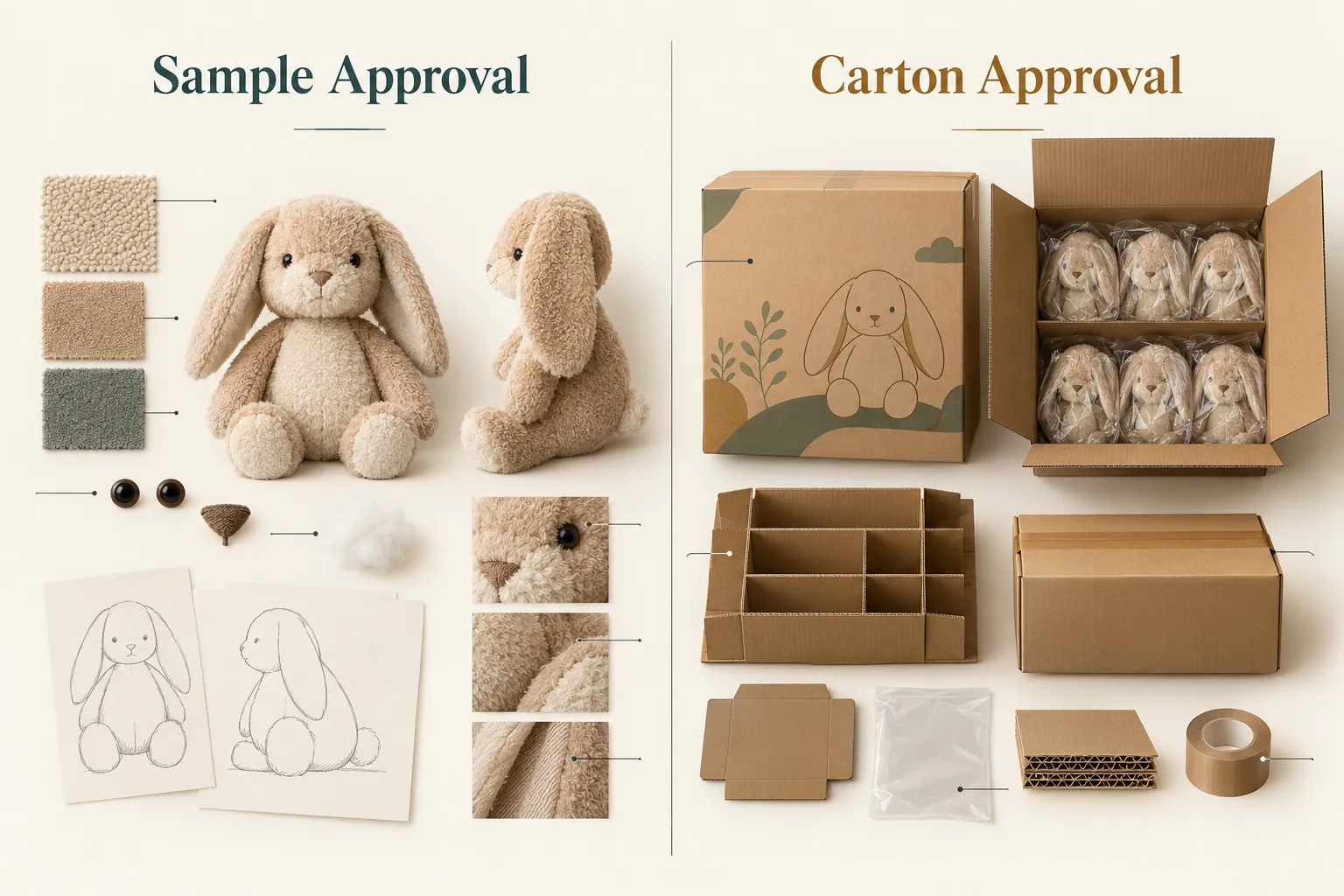
What is the buyer actually approving at sample approval versus carton approval?
| Object of approval | Sample approval: a named physical sample and specification revision, with the reviewed characteristics identified. Carton approval: an identified production lot, its packing configuration and the inspection evidence reviewed. |
|---|---|
| Product mechanism and contents | Sample approval: examine the intended assembly, component list and relevant function. Carton approval: check selected production units against that reference; record how units and cartons were selected and how much was inspected. |
| Material and color | Sample approval: record the specified materials and agreed color reference, distinguishing physical appearance from material identification. Carton approval: compare production observations and relevant material records with the approved specification. Appearance alone does not establish resin or alloy composition. |
| Logo and retail packaging | Sample approval: identify the approved logo, artwork revision, box structure and physical proof reviewed. Carton approval: check the actual packed product for the correct printing, labels, inserts and presentation. |
| Carton quantity and packed condition | Sample approval: agree the intended packing configuration if it is within scope. Carton approval: verify the packed quantity, carton identification and condition using the agreed inspection method. |
| MOQ and commercial configuration | Neither approval gate establishes a commercial MOQ. Confirm the exact product, sales unit, color, branding and packaging configuration in the quotation; keep those terms separate from the approval result. |
| Age and destination documents | At sample review, identify the intended age grade, destination and documents to be reviewed. At lot release, check that the relevant documents correspond to the actual configuration and any approved changes. A visual approval is not a substitute for applicable testing or qualified review. |
| Limits of the decision | A sample establishes only the characteristics actually reviewed. A packed-lot inspection supports a decision within its recorded scope; it does not mean every unit was examined. |
Blue Castle and Go-Kart Racing Building Block Set 53PCS
| Product and assortment choice | Blue Castle: a castle-themed product reference. Go-Kart Racing Building Block Set 53PCS: a vehicle-themed building set with a die-cast alloy car. Choose by the intended assortment role, then approve the exact contents rather than the product name alone. |
|---|---|
| Recorded material | Blue Castle: ABS. Go-Kart Racing Building Block Set 53PCS: ABS plastic with a die-cast alloy car. Define component-level materials in the OEM specification rather than assuming one material field describes every part. |
| Recorded retail packaging | Both references list a color box. This does not establish matching box dimensions, artwork, inserts or master-carton construction. |
| Reference MOQ | Blue Castle: 72. Go-Kart Racing Building Block Set 53PCS: 216. Confirm the quoted sales unit and configuration for each; neither reference MOQ establishes a custom-color, logo or custom-box MOQ. |
| Recorded units per carton | Blue Castle: 36 catalog units. Go-Kart Racing Building Block Set 53PCS: 72 catalog units. Confirm what constitutes one packed sales unit. Carton quantity is not automatically an ordering multiple. |
| Sample-review consequence | For Blue Castle, establish the exact contents and assembly requirements before approving the reference. For the go-kart set, reconcile the 53-piece description with a component list and confirm how the included car is counted; do not assume it is an additional piece. |
Which sample evidence is enough to approve color, logo and packaging?
Approve only the characteristics the evidence actually demonstrates: an existing-product sample can support a product review without approving your final logo or custom box.
If retaining the existing configuration, request confirmation of the available color, quantity, replenishment conditions and whether the supplied sample represents the proposed order. A catalog color or product name does not establish stock availability. If changing color, logo or packaging, request a configuration-specific quotation and identify the physical sample or proof needed before release; do not carry the base MOQ into that customization decision.
A stock or blank sample does not prove final branding or modified production details. Likewise, a 3D-printed prototype may support shape or assembly review without proving the final injection-molded material, finish or strength. Record those limits explicitly. Toy Sampling & Quality Control
For the go-kart set, approving block fit is not the same as approving the included car or printed box. For Blue Castle, approving a box image is not approval of the contents. Use separate evidence references when those items are reviewed at different times.
What should the approval record contain before production or shipment release?
| Product, order and record identity | Enter the product name, supplier model identifier, buyer item identifier, order reference, approval-record number and record revision. For carton approval, add the production lot and carton identifiers. |
|---|---|
| Gate and requested next action | Select sample approval or carton approval. State the requested authorization precisely: establish the reference, release production, permit corrective work or release the identified shipment. |
| Approved reference and revision | Identify the physical sample, specification revision, component list, color reference and artwork/packaging revision. At carton approval, cite the previously approved versions and any authorized changes. |
| Specified target | Record the agreed requirements for each characteristic being reviewed: contents, assembly or function, component materials, color, branding, retail pack and master-carton configuration. Include agreed acceptance criteria. |
| Observed result | Record what was actually observed beside each target, including measured results where relevant. Distinguish a match, a deviation and a characteristic not examined. |
| Evidence and inspection scope | Reference the sample, photographs, video, proof, inspection report and relevant document versions. For packed-lot review, record units/cartons examined, selection method, inspection date and inspector. |
| Decision and release conditions | Select approved for the stated scope, approved with explicit restrictions, or held for correction/review. State exactly which next action is permitted and which actions remain blocked. |
| Responsible approver and date | Enter the authorized approver’s name, role, decision date and acknowledgment or signature. Identify separate product, packaging or release approvers where responsibilities differ. |
| Open conditions and ownership | For every unresolved condition, name the required action, responsible owner, due date, closure evidence and whether it blocks production or shipment. |
| Follow-up closure | Record the correction or additional evidence received, reinspection result where relevant, closure approver and closure date. Issue the final release decision against the updated record. |
What should happen when a material, component or package changes after approval?
Record the change and reassess the affected approval scope before authorizing the next step; do not silently carry an earlier approval onto a different configuration.
For the go-kart set, a change to the included car should trigger a review of that component and its relationship to the approved contents and packaging. A Blue Castle box-art change may call for a revised packaging proof without reopening an unchanged product assembly. Material or structural changes deserve a broader review of the affected specification and supporting documents. These are recommended purchasing controls, not a claim that every change requires the same evidence or a new test.
Preserve valid evidence for unchanged characteristics, identify what needs renewed review and assign the closure decision. A revision record supports traceability; it cannot by itself prevent or reveal an undisclosed substitution.
Keep the final distinction intact: a sample can help assess the design, but it does not guarantee production consistency or replace testing and qualified review where needed. Carton approval adds evidence about the identified packed lot—not a retroactive cure for an unresolved sample decision. Concept-to-Production Roadmap
APPLY THE GUIDE
Build a quote around the order you plan to place.
Bring the product, destination, expected quantity and date into one brief.
Start a sourcing brief